Collection: Pavé
A truly exceptional pavé band should look like a solid ribbon of diamonds. Many rings on the market use thick prongs that leave the band feeling bumpy and rough. Instead of continuous brilliance, you end up with a high-profile ring that constantly snags on your sweaters or catches on delicate fabrics.
We approach our pavé settings with strict attention to proportion and everyday comfort. By carefully selecting precision-cut lab grown diamonds and securing them with meticulous micro prongs, we create a slender, flawless ribbon of fire. The diamonds catch the light from every direction to amplify your center stone. You get a brilliant row of intense fire with the heavy structural integrity required for a lifetime of daily wear.

-
Vendor:Elora Fine Jewelry
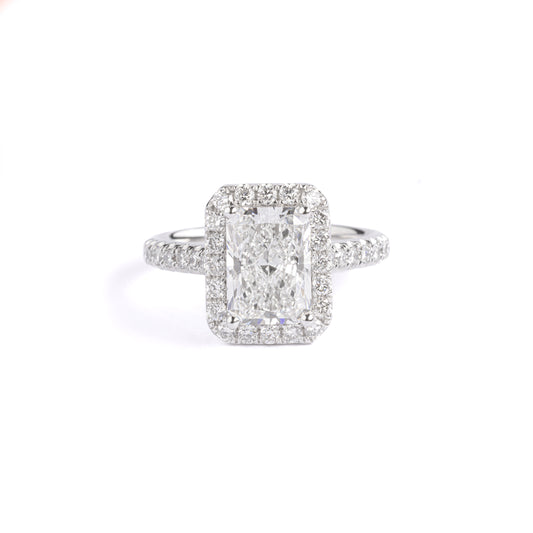
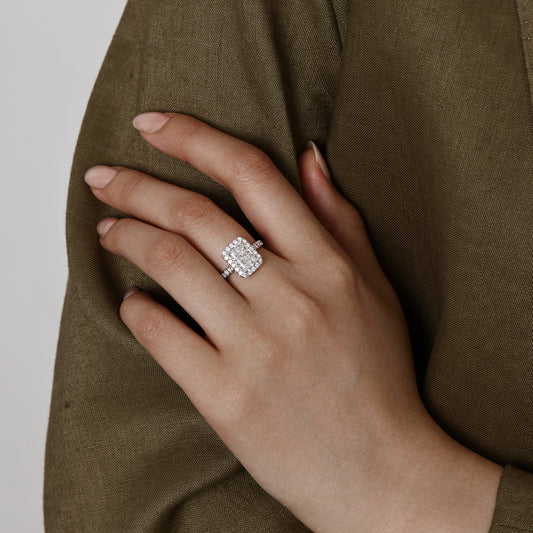
Briella-Radiant Cut Lab Grown Diamond Ring
Regular price From $1,299.00From $1,299.00 Regular priceUnit price per$1,299.00Sale price -
Vendor:Elora Fine Jewelry
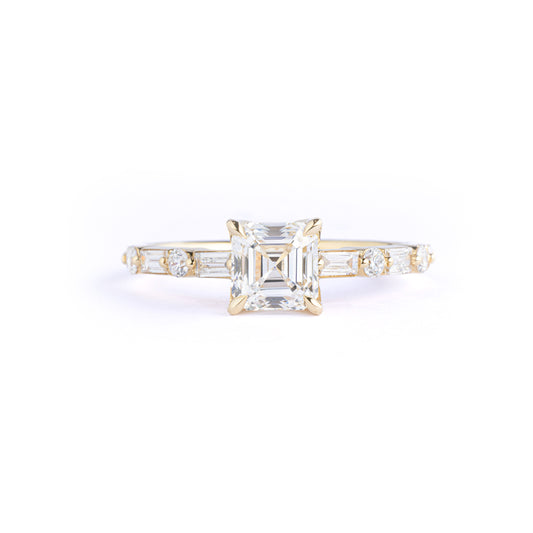
Keisha-Asscher Cut Lab Grown Diamond Ring
Regular price From $1,099.00From $1,099.00 Regular priceUnit price per -
Vendor:Elora Fine Jewelry
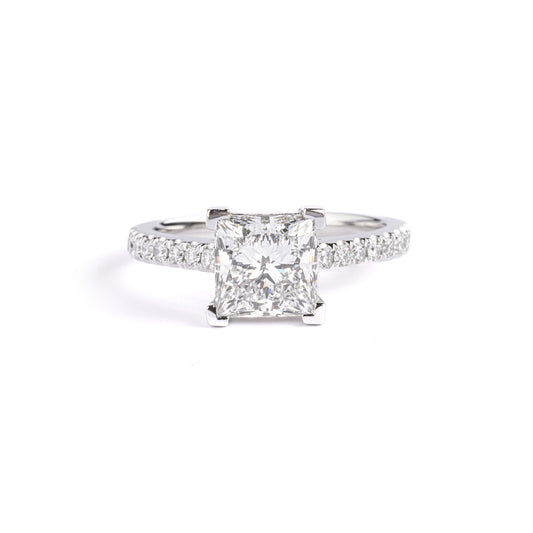
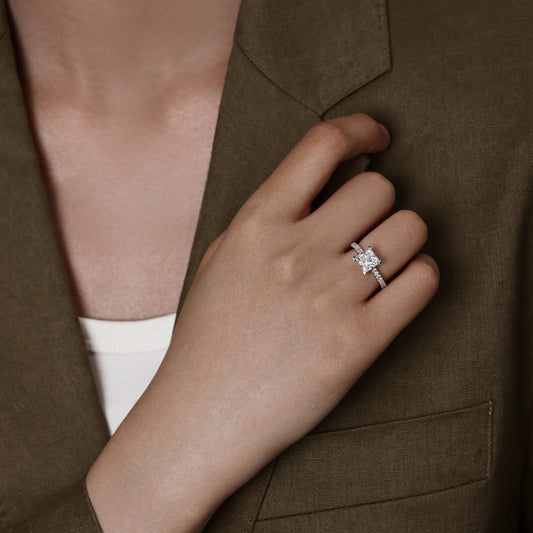
Heidi-Princess Cut Lab Grown Diamond Ring
Regular price From $1,299.00From $1,299.00 Regular priceUnit price per -
Vendor:Elora Lab Diamond Jewelry
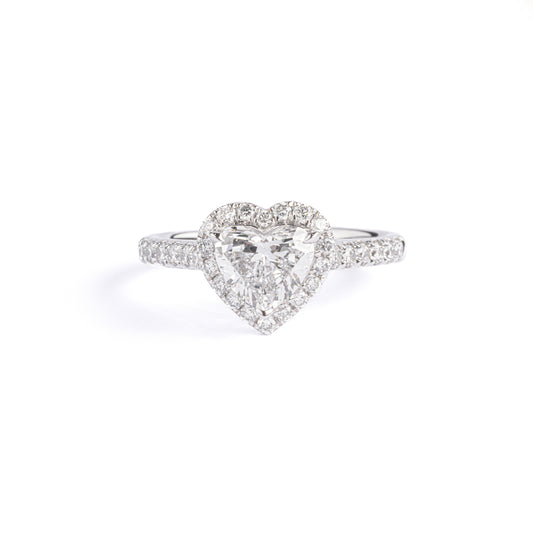
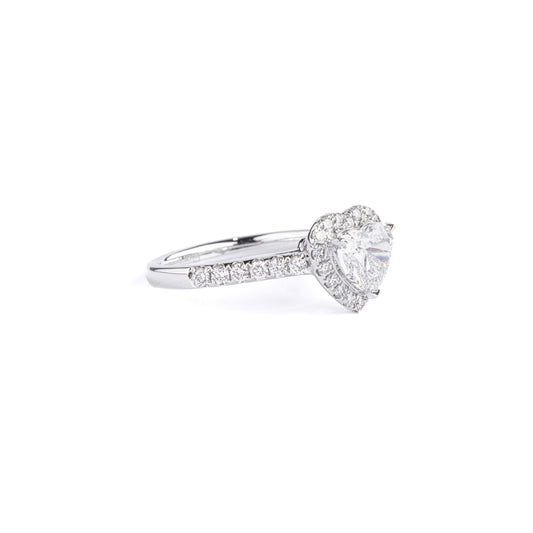
Anica-Heart Cut Lab Grown Diamond Ring
Regular price From $1,299.00From $1,299.00 Regular priceUnit price per
The Physics of Proportional Accent Scaling
A successfully engineered pavé ring relies on strict dimensional hierarchy. When the band is cast too wide or the side stones are oversized, the resulting visual weight actively diminishes the perceived size of the center diamond.
We combat this optical illusion by utilizing micro-calibrated lab grown diamonds. In designs like the Briella Radiant Cut Ring, we maintain an extremely tight tolerance on the diameter of our accent stones to create a continuous, ultra-slender line of refraction. This severe contrast in scale forces the eye upward, ensuring the center stone remains the undisputed focal point and maximizing its visual carat weight.
Micro-Prong Architecture and Shear Resistance
The structural failure of a pavé band usually stems from inadequate prong design. Standard commercial settings rely on thick, shared prongs that not only look bulky but create snag points. When these exposed prongs catch on fabric, the resulting shear force bends the metal and releases the diamond.
We bypass this failure point entirely. Each accent stone in our collection is anchored by its own dedicated micro-prongs. Our setters cut precise seats into the band, seating the lab grown diamonds slightly below the absolute edge of the metal profile. This specific geometry physically shields the stones from direct impact, providing massive structural integrity without sacrificing the delicate aesthetic of the band.
Managing Vertical Profile and Ergonomics
Securing a row of diamonds naturally requires a specific depth of metal. In mass production, this often results in a cumbersome, high-profile shank that forces the adjacent fingers apart, creating long-term ergonomic discomfort.
We engineer our shanks for low-profile wearability. By utilizing high-density gold and platinum alloys, we can safely sink the micro diamonds into a reinforced, yet remarkably shallow channel. This allows the band to sit incredibly close to the finger. It eliminates the bulky, industrial feel common in heavily set rings, ensuring the piece slides on smoothly and remains comfortable during continuous daily wear.
Strict Cut Tolerances for Micro-Diamonds
The overall fire of a pavé band is dictated entirely by the cut geometry of its smallest stones. When diamonds are scaled down to millimeter dimensions, mass manufacturers often abandon ideal cut proportions, resulting in a band that exhibits dark spots or a lifeless, glass-like appearance.
We apply the same rigorous cut parameters to our micro-diamonds as we do to our center stones. Every accent diamond set into the Heidi Princess Cut Ring is a fully faceted brilliant cut, mathematically calibrated for exact symmetry and optimal light return. This strict optical consistency ensures that light reflects simultaneously across the entire width of the band, creating a continuous ribbon of fire that matches the intensity of the center lab-grown diamond.