Kategorie: Blauer Edelstein
Entdecken Sie Eloras Kollektion leuchtend blauer Edelsteine, von ozeanblauen Saphiren bis zu eisigen Aquamarinen. Jeder Ring fängt eine ruhige, zeitlose Eleganz für Ihre edle Schmucksammlung ein.

-
Anbieter:Elora Fine Jewelry
Jill-Cushion-Schliff Lab Grown Minzgrüner Saphir Edelsteinring
Normaler Preis $1,899.00$1,899.00 Normaler PreisStückpreis pro -
Anbieter:Elora Fine Jewelry
Juno-Ring mit oval geschliffenem Paraiba-Edelstein (im Labor hergestellt)
Normaler Preis $3,799.00$3,799.00 Normaler PreisStückpreis pro -
Anbieter:Elora Fine Jewelry
Runder Lab Grown Blauer Saphir Eternity Ring
Normaler Preis $1,399.00$1,399.00 Normaler PreisStückpreis pro -
Anbieter:Elora Fine Jewelry
Baguette-geschliffener Topas-Edelstein-Eternity-Ring
Normaler Preis $999.00$999.00 Normaler PreisStückpreis pro -
Anbieter:Elora Fine Jewelry
Evie-Ring mit oval geschliffenem Paraiba-Edelstein (im Labor gezüchtet)
Normaler Preis $1,299.00$1,299.00 Normaler PreisStückpreis pro -
Anbieter:Elora Fine Jewelry
Sarah-Sugarloaf Cabochon Himmelblauer Aquamarin Edelsteinring
Normaler Preis $1,199.00$1,199.00 Normaler PreisStückpreis pro -
Anbieter:Elora Fine Jewelry
Juno-Ring mit oval geschliffenem Paraiba-Edelstein (im Labor hergestellt)
Normaler Preis $1,299.00$1,299.00 Normaler PreisStückpreis pro







What Separates One Blue from Another
Blue is the most requested color in fine jewelry, and the reason is partly that it covers such different territory depending on the stone. The blue of aquamarine and the blue of sapphire are both genuinely blue, but they have almost nothing else in common. Aquamarine is beryl, the same mineral family as emerald, and its color comes from iron at low concentrations. The result is a pale, cool blue with high transparency and a lightness that suits the stone's natural clarity. It does not compete for attention. It sits quietly and lets the light through.
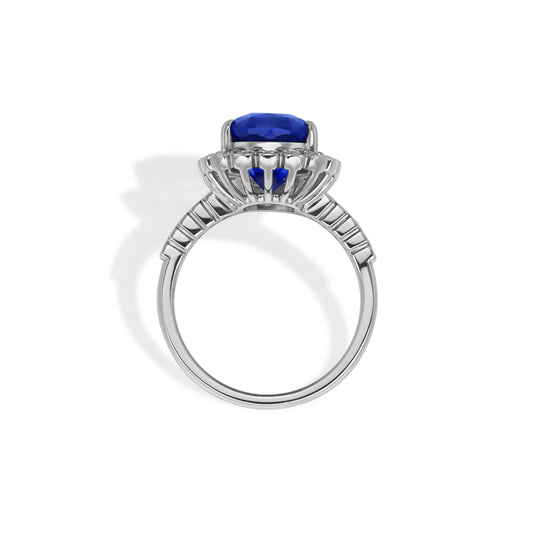
Sapphire is corundum, and its blue comes from iron and titanium at higher concentrations. The color is denser, more saturated, and more stable across different lighting conditions. Where aquamarine can look almost colorless in low light, sapphire holds its blue. The round-cut sapphire eternity band in this collection uses that stability: the stones read consistently around the band regardless of the angle or the light source.
Paraiba and the Outlier Blue
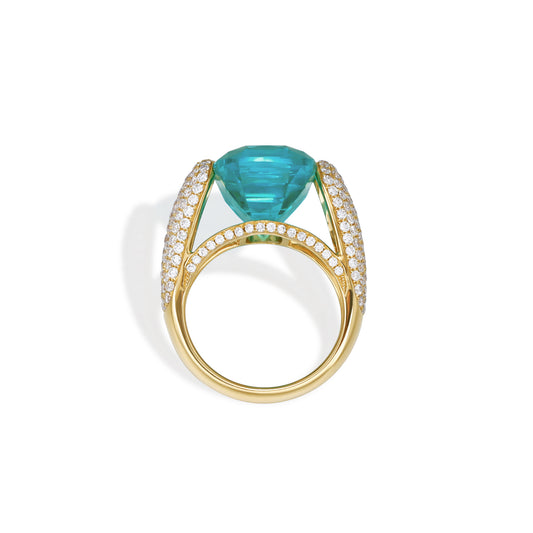
Paraiba tourmaline does not fit neatly into the blue spectrum. Its color comes from copper rather than iron or titanium, and the result is a blue-green or teal with a neon intensity that is unlike any other gemstone. It is not a calm blue. It is a blue that draws attention, that reads differently from across a room than it does up close. The two paraiba pieces here are oval cuts that maximize the stone's color across the table, which is where the copper-driven saturation is most visible.
Frequently Asked Questions
Both are pale to medium blue stones, but they differ in origin and character. Aquamarine is beryl with a natural blue color from iron. Blue topaz is typically colorless topaz that has been irradiated and heat-treated to produce blue. Aquamarine tends toward a purer, slightly greener blue. Blue topaz is often more saturated and more purely blue. Both are suitable for daily wear, though topaz at Mohs 8 is harder than aquamarine at 7.5 to 8.
Natural paraiba tourmaline from the original Brazilian deposit in Paraíba state is among the rarest gemstones in the world. The copper that gives it its distinctive color is found in very few locations, and the original deposit is largely exhausted. Stones from later discoveries in Mozambique and Nigeria share the copper coloring but command lower prices. Lab-grown paraiba replicates the copper-colored character without the rarity premium.
Sapphire is the most durable at Mohs 9. Topaz follows at Mohs 8, though its perfect cleavage means it is more vulnerable to splitting from impact than its hardness suggests. Aquamarine sits at 7.5 to 8 with no significant cleavage concerns. Tourmaline, including paraiba, is 7 to 7.5. For a ring worn daily, sapphire is the most practical choice among the blues.